

Why generative engine optimization pricing sits higher
Standard SEO has an economic advantage that nobody talks about: the research is reusable.
Keyword volumes come from a database. Competitor rankings come from the same database. An agency pays for the subscription once and serves every client from it. Most of what you pay for is interpretation rather than discovery.
Generative engines break that. There is no database of how an assistant describes your category, because the answer is generated fresh, varies by phrasing and changes as models update. The only way to know is to ask, repeatedly, and read what comes back.
That is human time, per client, per category, and it does not amortise across an agency’s book.
What that means for the quote
Expect GEO to appear on mid and upper tiers rather than entry plans, and treat an unusually cheap offer as a signal that somebody is reselling the same generic advice to everybody.
Citelane’s structure shows the pattern: GEO is not in the $3,000 Growth plan at all, appears at Full Discovery for $6,000 a month alongside tracking across four engines and a monthly visibility audit, and becomes dedicated research at Enterprise from $12,000. Whether or not those figures suit you, the shape is the honest one.
What the work consists of
Four activities, and only one of them looks like traditional SEO.
| Activity | What it involves | Why it costs what it does |
|---|---|---|
| Question discovery | Asking engines how buyers phrase the problem | Manual, per category, not purchasable |
| Source mapping | Finding which sources the engine already trusts | Reading answers and recording citations |
| Entity work | Making your company legible as a thing, not a page | Markup, consistency, third party corroboration |
| Answer structuring | Rewriting so a passage can be quoted cleanly | Closest to ordinary content work |
Row two is the one teams underestimate. Generative engines rarely quote a company describing itself. They quote other people describing it, which means a large part of the work happens off your website entirely.
That is also why GEO quotes vary so much. An agency pricing only the on-page half will look cheaper and will be selling half the job.
The entity question
Making a company legible as an entity means the same facts appearing consistently wherever you are described: the category you are in, who you serve, what you do. Inconsistency across your site, your directory listings and your documentation makes you harder to summarise.
Structured data helps and is not sufficient. the schema.org getting started guide is the plain starting point, and Google’s list of supported structured data types narrows the list of types worth the effort considerably.
What to ask before accepting a GEO quote
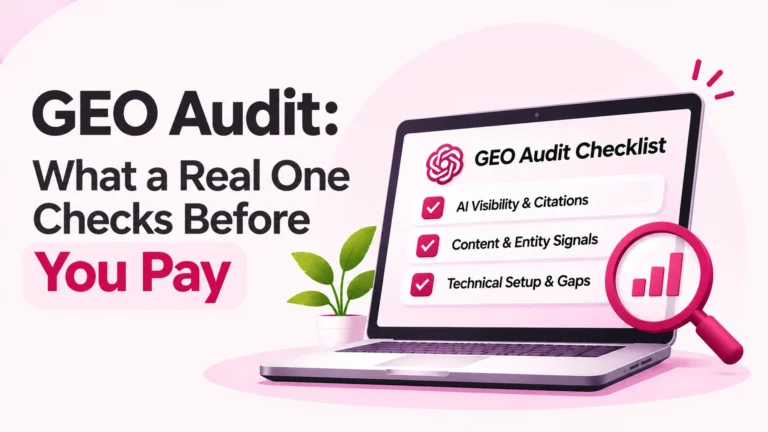
Five questions. The answers separate the people doing the work from the people repackaging an SEO retainer.
Which engines, and how often do you query them? A specific answer names the engines and the cadence. A vague one lists the engines.
How do you find the questions? If the answer is keyword research, they are doing SEO and calling it GEO. The questions people ask assistants are longer, more conversational and often absent from keyword tools entirely.
What proportion of the work is off site? If the answer is none, they are selling the on-page half.
Show me a citation report from another account. Redacted is fine. The format tells you whether this is a practised process or a new line on the rate card.
What would make you tell us to wait? Anyone genuinely experienced can name a situation. Thin content, an unindexed site, or a category where assistants currently return nothing useful are all real answers.
The cheap tell
Ask them to describe, in one sentence, the difference between what they do for AI Overviews and what they do for ChatGPT. The engines surface sources differently and the work is not identical. A fluent answer takes five seconds. A pause is informative.
When GEO is the wrong purchase right now
Four situations where the money is better spent on something else first, and an honest supplier will say so.
Your pages are not indexed. If a search engine cannot see the page, a generative engine built on that index will not cite it. Fix crawling and indexing before paying for anything downstream.
Your content is thin. Engines quote passages. If there is no passage that answers the question well, there is nothing to quote, and no amount of markup changes that.
Nobody else mentions you. If no review site, publication or community discusses your product, the engines have nothing to draw on besides your own marketing, which they weight lightly. The fix is mentions, which is a PR and outreach problem.
Assistants return nothing useful for your category yet. Some niches are genuinely not covered well. Ask ten buyer questions in two engines. If the answers are vague for everybody, your competitors are not winning either, and the urgency is lower than the pitch suggests.
That last check costs an afternoon and nothing else. Run it before spending anything.
What to buy instead, in that order
Indexing and technical hygiene. Then enough depth that a passage exists worth quoting. Then third party mentions. Then GEO, which arranges and amplifies all three rather than substituting for them.
The decision table
| Situation | Scale | Setup | Primary pain | Recommended starting point |
|---|---|---|---|---|
| Site not fully indexed | Any | Technical debt | Invisible to everything | Fix indexing first, GEO later |
| Thin content, few pages | Seed | Little published | Nothing to quote | Build depth before buying GEO |
| Good content, no mentions | Series A | Publishing well | No third party corroboration | Outreach and PR, then GEO |
| Competitors cited, you are not | Any | Everything else working | Specific visibility gap | GEO, scoped to the gap |
| Multi-market, several languages | Series B+ | Mature programme | Coverage at scale | Upper tier with dedicated research |
Measuring what you bought
GEO reporting is immature across the whole market, which makes it easy to be sold activity instead of outcome.
Three measures are worth insisting on.
Citation rate against a fixed question set. Agree fifty questions at the start and never change them. If the set changes, the trend is meaningless, and changing it is the easiest way for any supplier to show improvement that did not happen.
Position within the answer. Being named first and being named last are different outcomes that most reports collapse into one.
Which sources are cited alongside you. This tells you where to work next and is the most actionable output of the whole programme.
What to ignore: anything expressed as a visibility score with no stated method. A composite number that nobody can reconstruct is not a measurement.
Expect the number to move around
Generated answers vary between identical queries and change when models update. A single week’s drop is noise. Judge on the trend across a quarter, and make sure your supplier reports the variance rather than only the best reading.
For the wider question of choosing a supplier, our guide to how to choose a generative engine optimization agency covers what to probe, and the published plans show which tier GEO starts at and what comes with it.
See which tier GEO starts at on the Citelane pricing page, or read our guide to choosing a generative engine optimization agency.
Frequently asked questions
Why does GEO cost more than standard SEO?
Because the research does not transfer between clients. Keyword volumes and competitor rankings come from databases an agency pays for once and uses for everybody. There is no equivalent database for how an assistant describes your category, since the answer is generated fresh and varies by phrasing. Finding out means asking repeatedly and reading the responses, which is human time that cannot be amortised.
What should generative engine optimization include?
Four things: discovering how buyers actually phrase the problem to an assistant, mapping which sources the engine already trusts in your category, entity work so your company is legible as a consistent thing rather than a set of pages, and restructuring content so a passage can be quoted cleanly. If a proposal covers only the last one, you are being sold the on-page half of the job.
Is GEO just SEO with a new name?
No, though plenty of proposals are. The clearest test is to ask how the questions are found. If the answer is keyword research, it is SEO relabelled, because the questions people ask assistants are longer, more conversational and frequently absent from keyword tools. The second test is what proportion of the work happens off your site, since engines rarely quote a company describing itself.
When should we not buy GEO yet?
When your pages are not indexed, when your content is too thin for any passage to be worth quoting, when nobody else mentions you anywhere, or when assistants return nothing useful for your category. That last one costs an afternoon to check: ask ten buyer questions in two engines. If the answers are vague for everyone, your competitors are not winning either and the urgency is lower than the pitch suggests.
Which tier does GEO usually start at?
Mid tier and above, because of the research cost. Citelane does not include it in the $3,000 Growth plan, introduces it at Full Discovery for $6,000 a month alongside tracking across four engines and a monthly visibility audit, and makes it dedicated research at Enterprise from $12,000. An unusually cheap standalone GEO offer usually means generic advice being resold to everyone.
How do we measure whether GEO worked?
Agree a fixed set of about fifty questions at the start and never change it, because changing the set is the easiest way to show improvement that did not happen. Track the citation rate against that set, your position within the answer rather than just presence, and which sources are cited alongside you. Ignore any composite visibility score whose method is not stated.
Why do the results move around so much?
Generated answers vary between identical queries and shift when models update, so a single week’s drop is noise rather than a signal. Judge on the trend across a quarter. Insist that your supplier reports the variance rather than the best reading from the month, because selective sampling is easy in this field and currently quite common.