
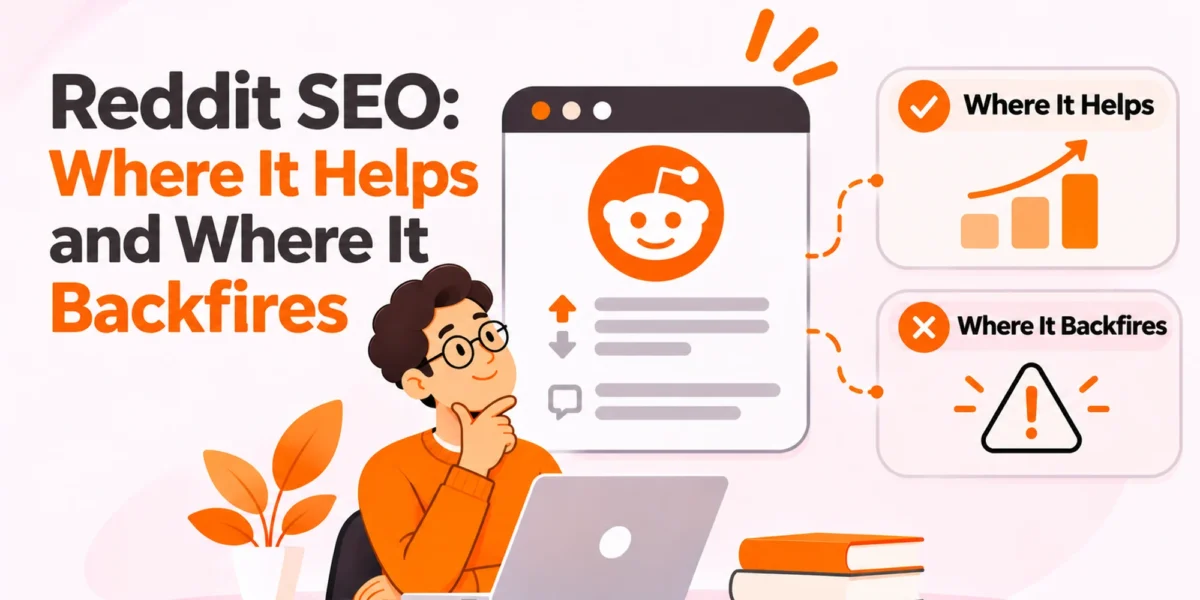
Why anyone cares about this now
Two reasons, and only one of them is about search engines.
First, buyers genuinely go there. People add a community name to a query because they want an opinion from somebody with nothing to sell. That behaviour is real and it predates any ranking change.
Second, the content is public, well structured and heavily linked, which makes it easy for any crawler to read. Google’s own list of its crawlers and fetchers lists the agents doing that reading.
What follows is where people go wrong. Those two facts describe why a community has visibility. They do not describe a channel you can operate like paid media.
The claim to be careful with
You will see confident figures about how much search traffic or how many AI citations this one site receives. Treat them carefully. Most are second hand, and the companies involved publish very little about it.
What actually works
Four things, and none of them is a campaign.
Read before you write. Search the communities your buyers use for your category, your competitors and the problem you solve. You will find questions you should have answered on your own site two years ago.
Answer as yourself, with your affiliation stated. Not a brand account. A named person who says where they work in the comment itself. Disclosed self interest is tolerated far better than discovered self interest.
Be useful when your product is not the answer. This is the part people skip and it is the part that earns the right to mention it later.
Fix what you learn. If three threads ask the same question, write the page. Google Search Central on creating helpful content describes exactly this kind of content, and the community told you what to write.
The uncomfortable timescale
Months, not weeks. Anyone offering results in a fortnight is describing one of the approaches in the next section, whether or not they say so plainly.
What fails, and how badly
Failure here is not neutral, which is what makes it different from most channels.
A removed post costs you nothing. A thread where your brand is named as astroturfing costs you a permanent, indexed, highly visible page that prospects will find when they search your name.
The approaches that produce that outcome are well known to anyone who spends time there. New accounts that post only about one product. Several accounts agreeing with each other. A question posted by one employee and answered by another. Purchased upvotes. Comments that read as though a template was filled in.
| Approach | Likely outcome | Recoverable? |
|---|---|---|
| Named employee answering honestly | Slow, positive | Not applicable |
| Brand account posting links | Removed | Yes |
| New account promoting one product | Removed, often banned | Usually |
| Coordinated accounts | Called out publicly | Rarely |
| Paid upvotes or accounts | Called out publicly | No |
Reddit’s published rules sets the floor, and individual communities enforce far stricter rules than that floor requires. Moderators are volunteers with wide discretion and long memories.
The link question, answered plainly
Most links from this source carry attributes that stop them passing ranking signals. So if your plan is link equity, the plan is already weak.
That is not the real problem though. The real problem is intent. the link spam section of those policies defines link spam as creating links primarily to manipulate rankings. An activity designed to place links in a community is that, whatever the attribute on the link.
Worth noting what the same policy does not say, because this surprises people. It never mentions disavowing links. And it describes buying and selling links as a normal part of the economy, provided they are qualified with the right attribute.
So the honest framing is this. Go for the audience, the questions and the reputation. If a link happens, treat it as a side effect rather than the objective, and the behaviour that follows will be the behaviour that works anyway.
The measurement that makes sense
Referral sessions, branded search volume, and the questions you learned to answer. Not link counts. Citelane’s link building work does not count this as a link channel for exactly this reason.
The answer engine angle, kept honest
Community content gets quoted by assistants. That is observable and it drives a lot of current advice.
Be careful about the leap that usually follows. Nobody publishes how sources are selected. Google’s documentation on its AI features in Search states there are no additional requirements and no special optimizations for Google’s AI features, and the other providers publish crawler behaviour rather than selection criteria.
So a vendor offering to get you cited by seeding community threads is selling an unverifiable mechanism and a reputational risk at the same time. That is a poor trade.
What does hold up is duller. If buyers ask a question in public and your site answers it well, you become a plausible source for both a search result and an assistant. The community told you the question. Your own page does the work.
A programme that will not embarrass you
Six steps, in order, and the first three involve no posting at all.
- Monitor. Find every existing mention of your brand and category. Read them.
- Correct the record only where it is factually wrong, as a named employee, briefly.
- Build the question list from what people actually ask.
- Write the pages those questions deserve, on your own site.
- Participate where your team genuinely knows the subject, with affiliation stated.
- Never buy accounts, upvotes or placements.
Steps one to four produce most of the value and carry no risk at all, because they happen on your own property. Running them in that order is deliberate.
Who should do it
Somebody who already reads these communities, and ideally somebody technical. A marketer assigned to it reads as a marketer assigned to it, usually within one comment.
This is awkward, because that person almost certainly does not report to marketing and has other work. The arrangement that tends to survive is a standing half hour, a shared document of what they found, and no posting quota at all.
A quota is what turns honest participation into a campaign. The moment somebody has to produce five comments a week, the comments get worse and the community notices before you do.
What to tell them they may say
Give them permission in advance to recommend a competitor when the competitor is the right answer. It sounds expensive and it is the single cheapest credibility you can buy, because it is also the thing nobody else is willing to do.
Put that permission in writing. Without it the person hesitates, hedges, and produces the kind of careful non answer that readers recognise instantly.
Citelane treats community research as input to your own pages rather than as a placement channel. See the full list of Citelane services or how Citelane prices engagements.
Frequently asked questions
Does reddit seo actually work?
The listening half works very well and the posting half works slowly or backfires. Reading the communities your buyers use tells you which questions to answer on your own site, which is valuable and carries no risk. Participating honestly as a named employee who states where they work can build real reputation over months. Treating it as a placement channel fails, and fails loudly, because the audience is unusually good at recognising exactly that.
Do links from Reddit help rankings?
Mostly not, because the links generally carry attributes that stop them passing ranking signals. The deeper issue is intent. Google’s policies define link spam as creating links primarily to manipulate rankings, and an activity designed to place links in a community is that regardless of the attribute. Go for the audience and the questions instead, and treat any link as a side effect. Measure referral sessions and branded search, not link counts.
What is the worst that can happen?
Not removal, which costs nothing. The bad outcome is a thread where your brand is publicly named as astroturfing, because that is permanent, indexed and highly visible to anyone searching your name. The approaches that produce it are well known to regulars: new accounts promoting one product, several accounts agreeing with each other, a question posted by one employee and answered by another, and purchased upvotes.
Should we post as the brand or as a person?
As a named person who states their affiliation in the comment itself. Disclosed self interest is tolerated far better than discovered self interest, and the discovery is what causes the damage. A brand account posting links is usually removed quickly. Ideally the person is somebody who already reads those communities and knows the subject technically, because a marketer assigned to the task tends to read as exactly that within one comment.
Will posting there get us cited by AI assistants?
Community content does get quoted, which is observable, but nobody publishes how sources are chosen. Google’s documentation states there are no additional requirements or special optimizations for its AI features, and other providers publish crawler behaviour rather than selection criteria. So an offer to get you cited by seeding threads combines an unverifiable mechanism with a real reputational risk, which is a poor trade in both directions.
What does Google’s policy actually say about this?
Two things worth knowing precisely. It defines link spam as creating links primarily to manipulate rankings, and it never mentions disavowing links anywhere on that page. It also describes buying and selling links as a normal part of the economy when they are qualified with the right attribute, which is more permissive than most summaries suggest. The violation is about intent and qualification rather than about the existence of a commercial relationship.
Where should we start?
With the three steps that involve no posting. Monitor every existing mention of your brand and category and read them properly. Correct the record only where something is factually wrong, briefly and as a named employee. Then build a question list from what people actually ask and write the pages those questions deserve on your own site. Most of the value sits in those steps and all of it happens on property you control.