
The constraint nobody puts in the proposal
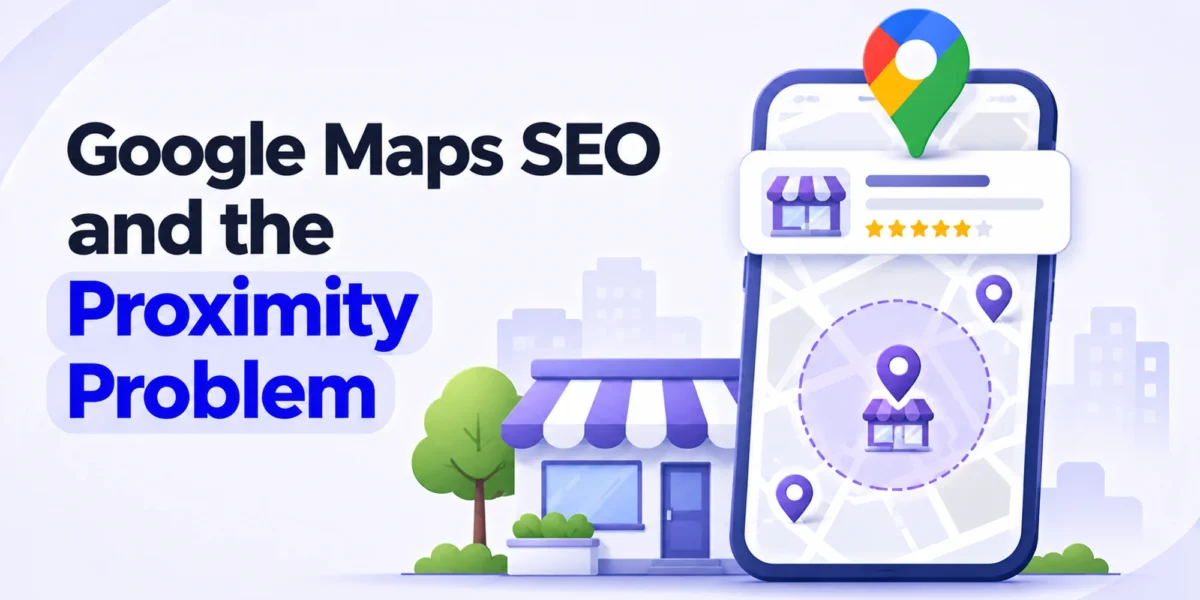
Local map results are personalised by where the searcher is standing. Two people in the same city, a few streets apart, can see different businesses in a different order for the same query.
That has a consequence most reporting ignores. There is no single position for your business. There is a different position at every point on the map, and the average of those is a number somebody chose how to calculate.
Google’s own guidance on local ranking factors lists the three things Google says it weighs: relevance, distance and prominence. Distance sits in the middle of that list and you cannot change it without moving premises.
What this does to a promise
Anybody guaranteeing a map position has either not understood this or is relying on you not to. Ask them where that position applies. The question is not rhetorical and the honest answer is that it depends on where the searcher is.
What you can actually move
Relevance and prominence are the two levers that remain, and they are not equally weighted.
Categories. The heaviest single thing you control. The primary category does the most work and most businesses have chosen it loosely. Getting it right is research: look at what the businesses already winning your queries use.
Services and attributes. Specific, complete, matching the words customers use rather than your internal product names.
The business name field. It is your actual name. Stuffing keywords into it works until it is reported, at which point the listing is at risk. Google’s rules on representing your business on Google is unambiguous and it is not a grey area.
Reviews and their content. Volume, recency and what the text actually says. Reviews mentioning a service tend to help that service.
The website behind it. Prominence draws on your wider presence, which is where ordinary SEO rejoins the picture.
Doing the category research properly
Choosing the primary category was called the heaviest lever above, which is easy to say and not obvious to act on. It is a research task with a method.
- List the five queries that actually bring you work. Not the highest volume ones. The ones that produce calls.
- Search each from inside your service area, rather than from wherever you happen to be, because the results are location dependent.
- Record the primary category of every business in the top results. This is visible on their listings and it is the whole exercise.
- Look for the pattern. Usually one category dominates, and frequently it is not the one you would have chosen for yourself.
- Change yours and watch for a few weeks before changing anything else, so you can tell what moved.
Two cautions. Changing the primary category can cause a short period of instability before it settles, so avoid doing it the week before your busiest season. And the most specific accurate category usually beats a broader one, because specificity is what makes you eligible for narrower queries where distance counts for less.
Secondary categories
Add them for services you genuinely provide, and stop there. They carry less weight than the primary one, and a long list of loosely related categories dilutes what the listing says about you rather than widening it.
Duplicate and suspended listings
Two problems that make all the other work pointless, and both are more common than most owners realise.
Duplicates arise from a previous owner, an agency that created a second listing rather than claiming the first, a move, or a name change. The effect is that reviews, photos and authority are split between two records, and either may be shown. Resolving them is tedious, and it is the highest return task on this list whenever it applies.
Suspensions usually follow a rule breach, most often a name containing keywords, an address that is not a real place of business, or a service area set up as though it were premises. Google’s rules on representing your business on Google sets out what is permitted and it is worth reading before anybody edits anything.
The practical point for a buyer: both are discovery findings rather than ongoing work. An agency should surface them inside the first fortnight. If you are three months into a retainer and a duplicate listing has never been mentioned, nobody has looked.
Service area settings, and what they do not do
This is the most common misunderstanding in the whole subject, so it is worth being blunt.
Setting a service area tells Google where you are willing to travel. It does not make you appear to searchers across that area. A business listing twenty towns does not thereby rank in twenty towns.
Service areas affect how your listing is presented and whether your address is shown. They are not a reach setting, and adding more of them is not a growth tactic.
| Setting | What it genuinely affects | What people expect wrongly |
|---|---|---|
| Primary category | Which queries you are eligible for | Treated as a minor field |
| Service area | Presentation and address display | Treated as a reach setting |
| Business name | Matching your real name | Treated as a keyword field |
| Hours | Eligibility for open now filters | Treated as cosmetic |
Hours deserve a line of their own. Wrong holiday hours do not just annoy people, they remove you from a filter many searchers use without thinking.
There is a second reason hours matter more than they look. A listing marked closed when you are open loses the click entirely, and you never see the loss, because nothing was recorded. That is the general shape of profile errors: they fail silently and they fail at the moment somebody was ready to act.
The same goes for the phone number and the link. Both are checked far less often than they change. A number that routes to a disconnected line or a link pointing at a page that no longer exists will sit there for months, because the listing keeps performing normally right up to the point where somebody tries to use it.
Measuring something real
If position varies by location, then measurement has to vary by location too.
Grid measurement samples your rank at many points across an area and shows the shape rather than a number. It reveals the thing that actually matters: how far out your visibility reaches before it falls away, and in which directions.
That shape is also the only honest way to see improvement. Visibility expanding outward is real progress. A single average moving from one decimal to another is noise dressed as reporting.
- Pick the queries that bring work, not the ones with the biggest volume.
- Sample across the area you can actually serve, including where you are weak.
- Record the shape at the start, before any changes, or you have nothing to compare.
- Watch calls and direction requests alongside it, because those are outcomes rather than positions.
which SEO measures are worth reporting goes further into which measures survive contact with a board meeting. The short version is that the profile’s own action data is more defensible than any rank figure.
When maps work will not fix your problem
Three honest limits.
You are in the wrong place. If competitors sit in the dense centre and you are on the edge of town, distance works against you permanently. The answer is to compete on the queries where relevance and prominence outweigh it, usually more specific services, rather than to fight for the broad term.
You have no premises and no service area. Then this is not your channel, and ordinary organic work is where your budget belongs.
Your profile is already well built. If categories, services, hours, photos and reviews are genuinely in order, the remaining map gains are small, and the next real wins are on the website. Google’s own SEO starter guide is the ground that work stands on.
Worth saying plainly: the ceiling here is lower than in ordinary SEO, and it arrives faster. That is not a reason to skip the work, which is cheap and effective. It is a reason to be suspicious of an indefinite retainer built on it.
Map visibility has a shape, not a number. See the full list of Citelane services or which SEO measures are worth reporting.
Frequently asked questions
What is google maps seo in practice?
Improving how and where your business appears in the map results, mainly through your Google Business Profile, your reviews, and the website behind it. The distinctive part is that results are personalised by the searcher’s location, so there is no single position to optimise toward.
Why do we rank differently depending on where we search from?
Because distance between the searcher and your premises is one of the factors Google says it weighs. It is not a bug and it cannot be configured away. It is also why checking your own rank from your own office gives a flattering and useless reading.
Does adding more service areas help us reach more customers?
No. Service areas describe where you are willing to work and affect how your listing is presented. They are not a reach control, and listing many areas does not make you appear across them.
Can we put keywords in our business name?
Not without putting the listing at risk. Google’s rules require the name to be the one you actually trade under. It sometimes works for a while, and the downside when it is reported is losing the listing rather than losing a ranking.
What is the single highest impact change we can make?
Usually the primary category, and most businesses have not thought hard about it. It decides which queries you are eligible for at all, which sits upstream of everything else you might tune.
How should we report on map visibility?
By sampling across a grid of locations rather than quoting one position, and alongside the actions people take on the profile such as calls and direction requests. A single average rank hides exactly the thing you need to see.
Do photos and posts affect map rankings?
Their direct ranking effect is modest and hard to isolate. Their effect on whether somebody chooses you after seeing the listing is substantial, which is a different and arguably more useful outcome than position.