
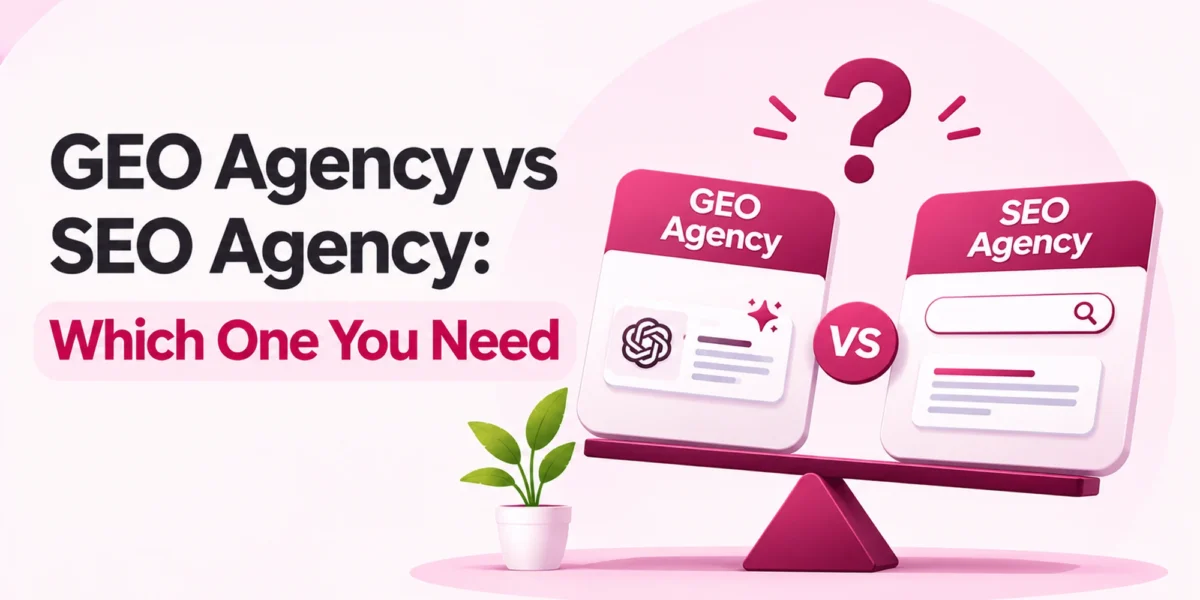
In the GEO agency vs SEO agency choice, the work is closer than the labels suggest. An SEO agency ranks your pages in Google’s results. A GEO agency gets your brand cited inside AI answers from ChatGPT, Perplexity and Google AI Overviews. Pick based on where your buyers now build their shortlist.
Last updated: 27 November 2026
That’s the short version. The longer one starts with a question most teams skip. Can the agency you already pay do both? If it can, you may not need a second one at all.
See where you stand in AI search
Get a free AI visibility audit: we check how ChatGPT, Perplexity and Google AI Overviews describe your brand today.
Get your free AI visibility audit →What each agency is paid to do
An SEO agency is paid to grow organic traffic from search engines. The work is familiar. Keyword research, technical SEO fixes, content, internal links and backlinks. Success shows up as rankings, clicks and sign-ups from Google.
A GEO agency, short for generative engine optimization, is paid to get your brand named in AI answers. It studies the prompts buyers type into ChatGPT, Gemini, Claude and Perplexity. Then it works on the pages and mentions those engines draw from.
Here’s the part both sides should agree on. Google says there is no special trick for its AI features. Its guide to AI features and your website says pages just need to be indexed and eligible to show with a snippet. Good SEO is the entry ticket.
So a GEO agency that ignores SEO basics is building on sand. And an SEO agency that ignores AI answers is reporting on a shrinking slice of the funnel.
Why the shift matters for B2B SaaS buyers
Buyers still search Google. But more of them now read an AI summary first and click less often.
A Pew Research Center study of real browsing data from 2025 found users clicked a traditional result on 8% of visits with an AI summary, against 15% without one. Ahrefs found about 58% lower click-through for the top-ranking page when an AI Overview shows, in its study of 300,000 keywords.
For a SaaS company, that changes what “winning” means. A ranking you can’t get clicks from is worth less than it was. A mention inside the answer is worth more.
GEO agency vs SEO agency: side by side
| What you are comparing | SEO agency | GEO agency |
|---|---|---|
| Main goal | Rank pages and grow organic clicks | Get your brand cited in AI answers |
| Core work | Technical SEO, keywords, content, backlinks | Prompt research, answer-first pages, mentions on trusted sources |
| Main report | Rankings, traffic, conversions | Citations and share of voice across AI engines |
| Engines in scope | Mostly Google and Bing | ChatGPT, Perplexity, Gemini, Claude, Google AI Overviews |
| Time to first signal | Weeks to months | A few months, and results vary by engine |
| Main risk | Rankings that no longer drive clicks | Chasing citations on pages that cannot rank or be crawled |
The table hides one thing. Most of the work in the middle rows overlaps. Clear pages, schema markup and trusted mentions help both scoreboards.
AEO agency vs SEO agency: the same question with a different label
You’ll also see “AEO agency”, short for answer engine optimization. In practice, AEO and GEO agencies sell the same outcome: being the answer, or being named in it. Some use AEO for short answers and GEO for longer AI summaries. Don’t let the acronym decide the hire.
Ask what they ship each month and how they prove it worked. That tells you more than the name on the proposal.
Test your current SEO agency before you hire a second one
Here is the step none of the guides on this topic seem to cover. If you already pay an SEO agency, test it first. A second agency means two retainers, two reports and two teams editing the same pages.
Send your current agency five questions in writing:
- Which buyer prompts do you track in AI tools, and on which engines?
- How often did ChatGPT or Perplexity name us last month, and which competitors were named instead?
- Which sources did those engines cite, and do we appear on any of them?
- What did you change on our site to be cited more often?
- What will you change next month, and how will you know if it worked?
Good answers with real numbers mean your SEO agency is already doing GEO work. Vague answers, or a promise to “look into AI search”, tell you the gap is real.
How to read the answers
Look for three things. First, a named list of prompts, not “we monitor AI”. Second, results split by engine, because ChatGPT, Perplexity and Google AI Overviews often name different brands for the same question. Third, a link between work done and results seen.
If the agency can show all three, the GEO agency vs SEO agency debate may be settled already. You have one partner doing both, and the fix is a bigger scope, not a new contract.
If it shows none, ask one more question. Would it rather partner with a specialist or learn the work itself? A good agency will give you a straight answer. A weak one will promise everything.
Do I need a GEO agency? Signs it’s time
You probably need GEO help, from a new partner or your current one, when these are true:
- Buyers tell your sales team they found you, or a rival, through ChatGPT or Perplexity.
- Rivals show up in AI answers for your category and you don’t.
- Your traffic is flat while rankings hold steady, a sign that clicks are being lost to AI answers.
- Nobody on your team owns AI search, and your SEO agency doesn’t report on it.
None of these signs means your SEO agency is bad at SEO. It may be very good at it. The question is narrower: can it measure and move the place where your buyers now form a view?
One quick check you can run today costs nothing. Open ChatGPT and Perplexity and ask the question a buyer would ask, such as “best tool for” your category. Note who gets named and which sites get cited.
Do it again next week. If rivals appear every time and you never do, you have your answer about the gap.
GEO agency vs SEO agency pricing: what drives the cost
There is no standard rate card for either. Price follows scope. The biggest cost drivers are the same on both sides:
- How many pages are written or rewritten each month.
- How much technical SEO work is included.
- How many buyer prompts and engines are tracked.
- Whether the agency earns mentions and links, or only advises.
- How senior the people doing the work are.
Tracking alone is cheap. Self-serve tools list prices such as Otterly.AI Lite at $29 a month for 20 prompts, or Peec AI Starter at $95 a month for 50 prompts. But a tool only measures the gap. Someone still has to close it.
At Citelane, plans start at $3,000 a month for Growth and $6,000 a month for Full Discovery, with Enterprise from $12,000 a month. Each plan covers both scoreboards, so SEO and GEO sit in one retainer. You can see what each plan includes on the Citelane pricing page.
Questions to ask about any quote
Whichever way you lean, ask each agency the same four questions about price:
- How many pages will you write or rewrite each month?
- Which engines and how many prompts are in the tracking?
- Is mention and link building included, or billed on top?
- What happens to the content and data if we end the contract?
The answers turn two quotes into a fair comparison. Without them, you’re comparing a price for reporting against a price for work.
When an SEO agency is still the right call
Don’t hire for AI search because it’s new. An SEO agency alone still makes sense when:
- Your site has basic technical problems. AI engines can’t cite pages they can’t crawl.
- You’re early, with little content. Building the base comes first.
- Your buyers search for very specific terms where Google still sends steady clicks.
In those cases, fix SEO first. Our technical SEO services cover that groundwork.
When a GEO agency is the better pick
A GEO specialist is worth it when the groundwork is done and AI answers now shape your buyers’ shortlist. That is common in B2B SaaS, where buyers ask ChatGPT for “the best tools for” their problem before they talk to sales.
It also fits when your SEO agency can’t, or won’t, report on AI citations. Two partners can work, but only if one owns each page and the reports don’t overlap. If you want both scoreboards in one place, our generative engine optimization services run alongside SEO rather than on top of it.
How to split work between two agencies
If you do keep two partners, write the split down before either one starts. Give each page one owner. The SEO agency might own technical fixes and blog content. The GEO agency might own comparison pages, FAQ content and outreach to review sites.
Then agree on one shared report. When two agencies send two decks, nobody can tell which work moved the numbers. And both will claim the wins.
Scenario: a Series A team with an SEO agency already in place
Here’s an illustrative scenario. A Series A SaaS company pays an SEO agency for content and technical work. Rankings are steady. Demo requests are flat.
Sales notes that new prospects mention ChatGPT. The head of marketing asks the SEO agency the five questions above. The agency tracks no prompts and has no citation data.
The team has two options. It can hire a GEO agency for AI search and keep the SEO agency, with a clear owner for each page. Or it can move to one agency that reports both scoreboards. It picks the second, because two teams editing the same pricing page was already causing friction.
Decision checklist: GEO agency, SEO agency or both?
Run through these before you sign anything:
- Can your current agency report AI citations by engine today?
- Are your key pages crawlable, fast and eligible for snippets?
- Do buyers mention AI tools in sales calls?
- Who will own each page if two agencies are involved?
- Does the proposal show what gets shipped each month, not only what gets reported?
- Will you own the content, the tracking data and the prompt list if you leave?
If you answer “no” to the first question and “yes” to the third, AI search is a real gap. Our answer engine optimization services are one way to close it.
When neither agency is the right call
Sometimes the answer is no agency yet. If you have no product-market fit, content won’t fix that.
If you have a strong in-house SEO lead, training them and adding a tracking tool may be enough. And if your budget only stretches to a few hundred dollars a month, a tool plus your own time beats a thin retainer that ships nothing.
So be honest about where you are. The right agency, GEO or SEO, should tell you when you’re not ready for it.
What a combined SEO and GEO report should show
Whoever you hire, the monthly report is where the GEO agency vs SEO agency question gets settled for good. A useful report puts both scoreboards on one page:
- Rankings and organic clicks for the pages that matter to revenue.
- The buyer prompts tracked, by engine, with whether you were named.
- Competitors named instead of you, and the sources the engines cited.
- What changed on the site or off it that month.
- What happens next month, and why.
If a report can’t connect changes to results, it is a record of activity, not proof of progress. Ask for the raw prompt list too, so you can rerun it yourself in ChatGPT or Perplexity and check.
Talk it through with us
Book a 30-minute discovery call. Bring your shortlist and we’ll tell you honestly whether you need a tool, an agency or neither.
Book a discovery call →Frequently asked questions
What is the main difference between a GEO agency and an SEO agency?
An SEO agency works to rank your pages in Google’s organic results and grow clicks. A GEO agency works to get your brand named and cited inside AI answers from tools like ChatGPT, Perplexity and Google AI Overviews. Much of the groundwork is shared, but the goals, the reports and the success measures are different.
Do I need a GEO agency if I already have an SEO agency?
Not always. If your SEO agency already tracks AI citations, writes answer-first pages and earns mentions on sites AI engines trust, a second agency adds cost and overlap. If it can’t report how often AI tools name you, a GEO specialist can fill that gap.
Is a GEO agency more expensive than an SEO agency?
Prices depend on scope, not the label. A GEO retainer that includes content, technical fixes and mention building can cost the same as a full SEO retainer, while tracking-only work costs less. Compare what each one ships per month and how each reports results, not just the monthly fee.
Can one agency do both GEO and SEO?
Yes, and for many B2B SaaS teams that is the simplest setup. The test is whether the agency reports two scoreboards: rankings and traffic for SEO, and citations and share of voice across AI engines for GEO. If it only shows one, you are buying one service under two names.
How long before a GEO agency shows results?
Expect the first signs to take a few months, since AI engines need time to find and trust new or changed pages. Be wary of any agency that promises a fixed number of citations by a fixed date. Nobody controls which sources an AI engine picks, so honest agencies promise method and tracking instead.
What should a GEO agency report each month?
A useful report shows the buyer prompts tracked, which AI engines named you, which competitors were named instead, and which sources those engines cited. It should also list what changed on your site or off it that month, so you can link the work to any shift in citations rather than taking it on trust.